Slides
| Select the number of slides to display. Options range between 1 to 20 slides.
Each slide displays a unique blog article, calendar event, or forum topic from the connected channel. These slides are always ordered from most to least recent.
Some additional behaviors to be aware of:- Pinning does not affect the ordering of the slideshow.
- Replies on forum posts cause the post to become more recent, changing the previous display order.
- Calendar events will only show events that are occurring within the next 6 months. This can result in the number of displayed events being less than the number of slides selected.
The default number of slides is 5.
|
|---|
Time
| Select the display time for each slide. Options range between 3 to 20 seconds.
The default value is 10 seconds.
|
|---|
Transition
| Select a transition animation. Options include:- Fade: The old slide fades out as the new slide fades in.
- Slide: The new slide slides in from the right to replace the old slide.
|
|---|
Image
| Select the position of a slide's image in relation to its text. Options include:- Above: Display the image above the content's title, summary, and body.
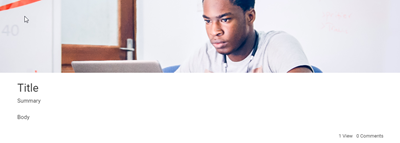 - Beside: Display the image to the right of the content's title, summary, and body.
 - Behind: Display the image behind.
 - No Image: Displays only the title, summary, and body.
Slides always display the first image in a blog article, calendar event, or forum topic. |
|---|
| Overlay | This option is only available if the Image setting is set to Behind.
Select an overlay style to apply to the image so that the text appearing above it is easier to read. Options include:- No Overlay: No mask is applied to the image.
 - Auto Overlay: A transparent mask is applied to the image. The coloring of this mask is based on the predominant colors in the image.
 - Fixed Overlay: A transparent mask is applied to the image. You can set the color of this mask.
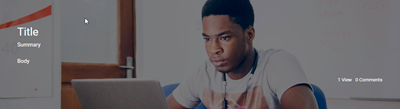
For most cases, we suggest using a Fixed Overlay with a black or white mask to help improve the readability of the title, summary, and body text. No Overlay is best used when you only want to display an image and no title, summary, and body text.
|
|---|
Dots
| Select to display navigation dots below the slideshow. Users can select these dots to go to a specific slide.
The dot of the current slide appears darker than the other dots.
|
|---|
Arrows
| Select to display navigation arrows on the left and right sides of the slideshow. Users can select these arrows to move to the previous (left arrow) or next slide (right arrow).
|
|---|
Title
| Select how much of a content's title is shown on a slide. Options include:- Don't show the title text (leftmost slider position)
- Between 5 to 35 characters in increments of 5 characters.
- Show full title (rightmost slider position)
|
|---|
Summary
| Select how much of a content's summary is shown on a slide. Options include:- Don't show summary text (leftmost slider position)
- Between 25 to 325 characters in increments of 25 characters.
- Show full summary (rightmost slider position)
|
|---|
| Body | Select how much of a content's body is shown on a slide. Options include:- Don't show body text (leftmost slider position)
- Between 50 to 650 characters in increments of 50 characters.
- Show full body text (rightmost slider position)
|
|---|
Read More
| Select whether a Read More button displays on slides. When a user selects Read More they will go to the related article. Display options include:- Off: The leftmost slider position. Don't display the Read More button.
- Contextual: The middle slider position. Display the Read More button only when there is additional body text.
- Always on: The rightmost slider position. Always display the Read More button.
|
|---|
Rating
| Select to display the rating of a blog article, calendar event, or forum topic. If the content has not been rated, no rating will display on the slide.
As of January 26, 2023, users can no longer rate blog articles. As a result, ratings that occurred before this change will be displayed.
|
|---|
Comments
| Select to display the number of comments on a blog article, calendar event, or forum topic. Users can select this to go to the comments section of the associated content.
|
|---|
Views
| Select to display the number of views on a blog article, calendar event, or forum topic. |
|---|

 Content Slideshow widget on a page, space, or dashboard. For more information, see
  Translation and enter a title for each supported language.